Retired Gynaecology Nurse Reveals a Simple Daily Wellness Method That Helps Nigerian Women With Fibroids Reduce Bloating, Pelvic Pain, and Heavy Periods — Without Surgery or Expensive Drugs
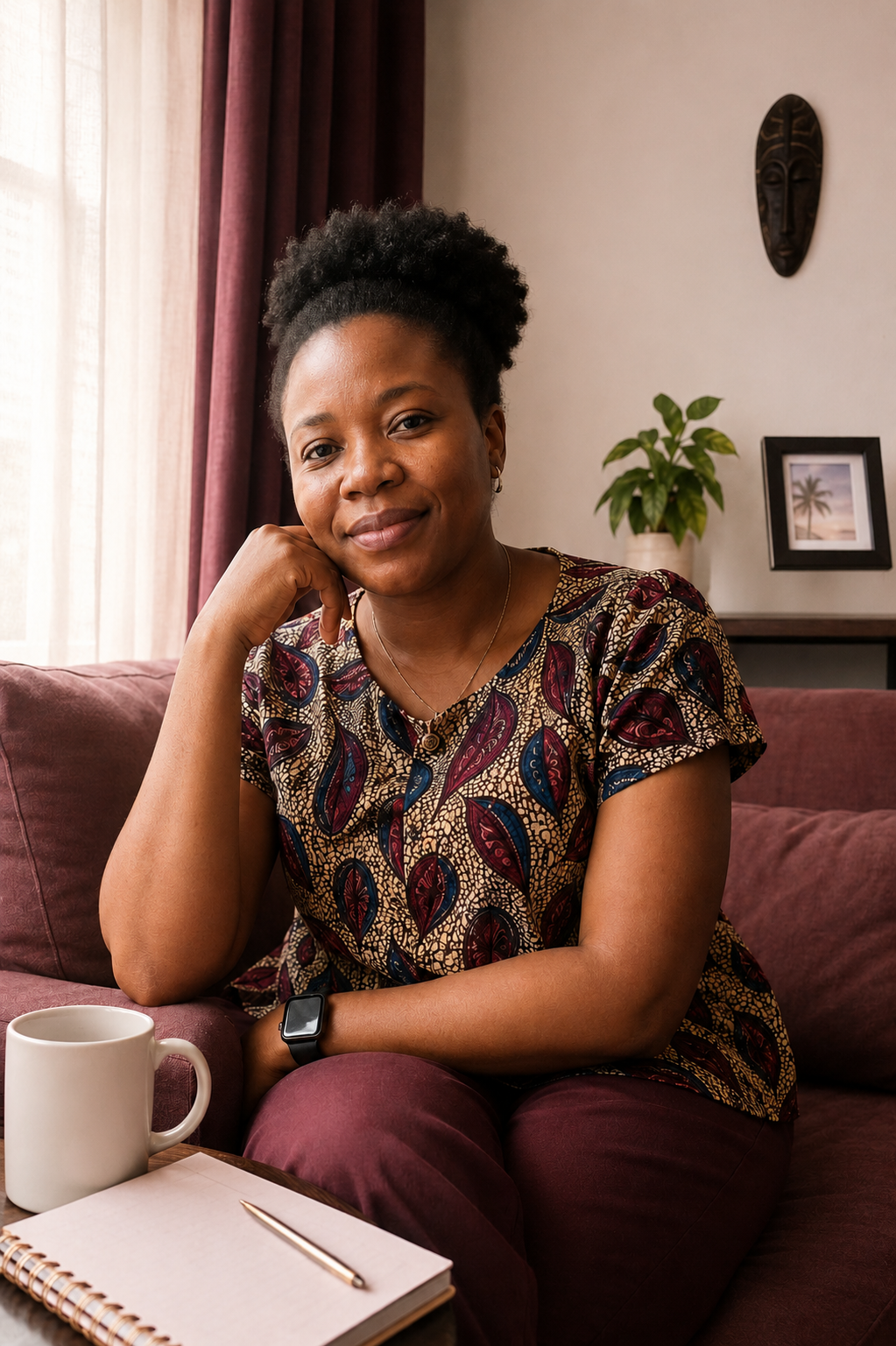
You know that feeling when your alarm goes off and — before your eyes even open properly — your body reminds you that today is one of those days.
The dull pressure in your lower abdomen. The fullness in your pelvis that doesn't go away no matter how you shift your position. The bloating that makes you look four months pregnant before 8am.
"Not again. Please. Not today."
You check the calendar. Your period is due in two days. You already know what's coming. Eight days — maybe ten — of soaking through pads in under two hours. Clots the size of things you don't want to describe. That dragging lower back pain that makes it impossible to sit at your desk without squirming.
You've started planning your month around your cycle. Dark trousers only. Extra pads in every handbag. No meetings on Day 2. No travel if you can help it. And you pray — you genuinely pray — that it won't happen in public.
"This is not how a 34-year-old woman is supposed to live."
You've been to the hospital. The doctor confirmed it — fibroids. Multiple, in your case. The scan report is still on your phone somewhere. You've read it so many times you could recite it word for word.
And the doctor's recommendation? Surgery. Myomectomy. "The sooner the better," he said, with the casual confidence of someone who would not be on the operating table.
You nodded. You took the referral letter. You went home. You sat on your bed and cried.
"I'm not ready. I can't afford it right now. And what if it comes back? What if something goes wrong?"
Since then, you've tried everything you could find. Supplements from Instagram pages. Herbal teas from WhatsApp vendors. Strict no-red-meat, no-dairy diets that lasted exactly three weeks before life intervened. You've read every blog, watched every YouTube video, bookmarked every thread on nairaland and Twitter about natural fibroid management.
Some things helped a little. Most things helped not at all. And your body — your beautiful, exhausted body — just kept carrying this burden every single month.
Your relationship has taken a toll. Your confidence has shrunk. There are events you've missed, conversations you've dodged, intimacy you've avoided — because your body doesn't feel like your own anymore.
"Maybe this is just my life now. Maybe this is just what I have to manage forever."
I need you to stop that thought right there.
Because I used to think exactly the same thing. Until one quiet evening under a mango tree in Udi, Enugu State — when a 71-year-old retired nurse changed everything I thought I knew about fibroids and what is actually possible without surgery.
Drop everything you are doing now and listen to every word I'm about to say.
"Because I'm about to share with you a simple daily wellness system that changed everything for me — and for over 200 Nigerian women I've quietly shared it with."
Our grandmothers knew things. Things that weren't written in textbooks or taught in medical schools. Quiet knowledge — passed from woman to woman, compound to compound — about how to support the female body through pain, through cycles, through seasons of life.
This method didn't come from a clinic in Lagos or a wellness centre in Abuja. It came from a woman who spent 28 years inside a major teaching hospital — watching what worked, what didn't, and what doctors never had time to explain to women before sending them home.
It was refined quietly over decades. No social media. No press. Just results — passed on one woman at a time, in kitchen conversations and compound gatherings, the way important things have always been shared in our culture.
And somehow, on Christmas Eve 2024, it found its way to me.
My name is Chiamaka Eze. I'm a school administrator from Enugu State, living in Lagos. I'm 34 years old, and until recently, I was exactly where you are right now — in pain, in fear, and running out of hope.
The first thing you should know about me is this: I am NOT a doctor. I am not a nurse, a naturopath, or a wellness expert. I'm just a regular woman who suffered for nearly three years — and who finally found something that actually worked.
I'm sharing this because I know how lonely this kind of pain feels. And because I wish someone had shared it with me sooner.
Let me take you back to July 2021.
I had been having heavy periods since I was a teenager — but nothing I couldn't manage. By 2020, things started to shift. My periods became heavier. Longer. The cramping was no longer just uncomfortable — it was stopping me from functioning.
By early 2021, I was bleeding for 10 to 12 days every cycle. I was soaking through large pads in under two hours on the heavy days. I was anemic — my hair was thinning, I was constantly tired, and I gained weight around my midsection that no amount of walking or clean eating touched.
"Your stomach is looking like a woman with belle," my neighbour said one afternoon, laughing — the way people laugh when they don't realise they're describing your worst fear.
I went to the hospital. The scan showed fibroids — multiple uterine fibroids, the largest measuring 6.2 centimetres. The doctor was calm, professional, and direct.
"Madam, at this size, the best option is myomectomy. We can schedule you within the next two months."
I nodded. I thanked him. I went home. And I put the referral letter in my bedside drawer where I wouldn't have to see it every day.
The emotional cost of those two years... I don't have enough words.
My husband Emeka — patient, kind, wonderful Emeka — stopped saying anything about intimacy after a while. Not because he didn't care. But because he could see it in my eyes: I was always in some level of pain. The pelvic pressure. The bloating. The exhaustion that came from carrying something heavy inside you, every single day.
We stopped going out as much. I started saying no to things I used to enjoy. I wore dark colours exclusively — not because I liked them, but because I was terrified of accidents in public. I kept an emergency change of clothes in my office bag for twelve months straight.
"Emeka must be tired of this," I thought sometimes, in the quiet hours when the compound was asleep. "A wife who can barely get through a month without falling apart."
He never said that. Not once. But the fear lived in me regardless.
My sister Ngozi pulled me aside one afternoon in October 2022. She held my face in her hands the way our mother used to, and she said:
She was right. I knew she was right. So I started fighting — in the only way I knew how: research.
Here is everything I tried over the next two years. And exactly why none of it gave me lasting relief:
1. Serrapeptase enzyme supplements. I spent ₦18,500 on a three-month supply from an Instagram vendor who promised they would "dissolve" the fibroids. Three months later, my scan showed zero change. My heavy periods continued. I felt foolish for believing it.
2. Hormonal injections (GnRH analogues). My doctor eventually prescribed Lupron injections to temporarily shrink the fibroids before potential surgery. The side effects were brutal — hot flashes every hour, mood swings that scared me, joint pain, and a complete collapse of my libido. I stopped after one injection cycle. The fibroids bounced back to their original size within months.
3. Herbal fibroid tea mixtures from WhatsApp vendors. I tried three different ones, each claiming to be "clinically formulated." One gave me mild relief from the bloating for a week or two. None of them changed my flow. None of them affected the pelvic pressure. When I asked for refunds, the vendors blocked me.
4. Strict "fibroid diet" from YouTube. No red meat. No dairy. No refined sugar. No soy. Organic only. The plan was good on paper. In Lagos traffic, on a school administrator's salary, with a husband and a household to feed — it lasted 21 days. I didn't have the time, the money, or the emotional energy to sustain it.
5. Vaginal steaming at a wellness spa in Lekki. ₦6,000 per session. The spa was beautiful and the staff were kind. I went four times. I felt relaxed afterwards — the same kind of relaxed you feel after a long shower. My fibroid symptoms didn't change by a single degree.
6. Monthly management with Ibuprofen and Tranexamic acid. This became my survival strategy. Not a solution. Just survival. Pop the tablets, reduce the bleeding slightly, get through the week. Repeat next month. Repeat the month after. Repeat forever, apparently.
By December 2024, I was exhausted. Financially strained from all the failed attempts. And quietly, dangerously close to just booking the surgery and getting it over with — not because I believed in it, but because I was simply too tired to keep searching.
That Christmas, I came home to Udi for the holidays.
I didn't realise how visibly unwell I looked until I saw my aunt's face when she opened the door. She studied me for a long moment — the way only Igbo aunties can study you — and then, without a word, she went inside to make a phone call.
That evening, after dinner, as the compound settled into its nighttime rhythm and the kerosene lanterns flickered on verandas, I heard my name called from across the yard.
"Chiamaka. Come and sit with me."
Mama Adaeze was 71, dressed simply in a wrapper and blouse, sitting in the low wooden chair she always kept under the mango tree. She spent 28 years as a gynaecology nurse at UNTH Enugu. Retired now, but still quietly known throughout Udi as the woman women visit when the doctors have said their piece and they're looking for something more.
She had a small notebook on her lap. The cover was faded and soft from years of handling.
She looked at me calmly and asked: "When last did you have a normal period?"
Something broke open in my chest. I started talking. And she listened — really listened — for nearly an hour and a half. She asked questions. She nodded. She made small sounds of recognition, like someone who had heard exactly this story many times before.
When I finished, she said something I will never forget:
I listened. Part of me wanted to believe. Part of me — the part that had spent ₦18,500 on serrapeptase and ₦24,000 on spa sessions — was sceptical.
"Mama, I have tried so many things," I said quietly.
She nodded. "I know. Everything you tried was either treating a symptom or it was too extreme to sustain. What I am going to share with you is different because it works with your body's own rhythms. You don't need to do anything dramatic. You need to do the right small things, every day."
For the next hour, she walked me through what she called her "Womb Support Routine" — a daily framework she had quietly built and refined over 28 years of clinical experience. She had written it all in that little notebook. Five components, each targeting a different root cause of fibroid-related suffering.
She explained which anti-inflammatory foods to eat and when. She taught me her warm compress technique — the exact oil, the exact temperature, how long, how often, and what to watch for. She described a herbal tea protocol using ingredients I could find in any Lagos market. She gave me a 15-minute daily movement sequence for pelvic circulation. And she named three household items I needed to remove from my environment immediately — things most Nigerian women use every single day without knowing they directly fuel fibroid growth.
I went home that Christmas with the notes I had scribbled on my phone. Honestly? I still wasn't sure I believed it would work. I had been disappointed too many times.
"Just try it for 30 days," Mama Adaeze had said. "Don't change everything overnight. Start with the compress and the tea. Then add the rest. The body needs time to respond — but it will respond."
So I started. New Year's Day 2025. I did the warm compress on my lower abdomen that first evening. I made the herbal tea the next morning. I kept at it.
The first week — nothing dramatic. Honestly, I was waiting for a miracle that didn't come. I wondered if I had been fooled again.
Day 9.
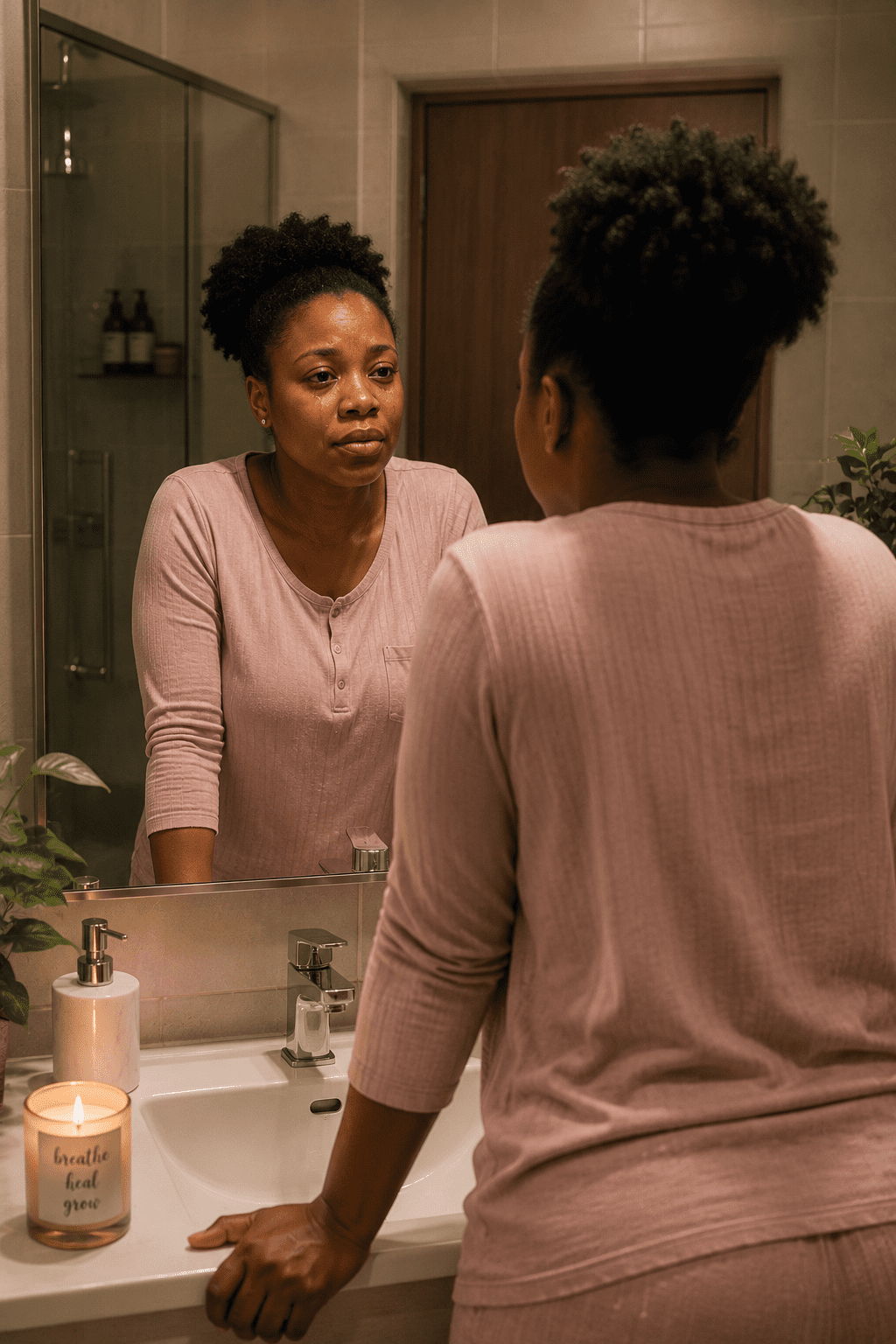
I was getting dressed for work. I looked in the mirror — and I paused.
My lower abdomen looked... different. The constant bloating I had carried for three years — that pregnant-looking fullness that never fully went away — had visibly reduced. I pressed gently. There was less tension. Less tightness.
I stood there in front of that mirror for a full minute, pressing gently, barely breathing.
"Is this real? Or am I imagining it?"
I wasn't imagining it.
By Week 3, my next cycle arrived. I had my pads ready, my change of clothes, my tablets. I braced myself for the usual storm.
It didn't come.
The flow was noticeably lighter. Not light — I'm not telling you it became a light period overnight. But manageable. I went through fewer pads in a day than I had in years. The clots were smaller. The cramping was present but not debilitating. And the period lasted 6 days — not 10.
I sat on the bathroom floor and cried. Quietly, with my back against the cold tile. Not from pain this time.
By Month 2, the pelvic pressure had reduced to a level I could genuinely call manageable. The lower back ache that had been my constant companion for three years had softened. My energy had returned — not completely, but enough that I was getting through full work days without the 2pm crash I had come to expect. I stopped dreading my cycle. That alone felt like a miracle.
One evening in late February, Emeka came home and found me cooking in the kitchen — just cooking, nothing special. He stood in the doorway for a moment without saying anything. Then he walked over, put his arms around me from behind, and said quietly:
I told him everything that night.
He listened. Then he asked: "Who else knows about this woman?"
It turns out — more people than I realised. When I went back to Udi in April for a naming ceremony, I discovered that three other women from the compound had also visited Mama Adaeze at different points. We ended up in her small parlour, the four of us, talking over suya and zobo.
Mrs. Okafor — 41, a civil servant from Enugu — had started the routine six months before me. Her scan at 4 months showed her largest fibroid had reduced from 4.8cm to 3.1cm. Her doctor was, in her words, "confused and suspicious and took the scan machine apart to check it."
Adaora — 29, a teacher — told me her period had gone from 11 days to 7 days after 6 weeks on the routine. "I cried in the toilet at school," she said, laughing. "My colleagues thought I was ill. I was actually just happy."
And Mama Ngozi — 46, who had been told surgery was her only option by three separate doctors — said the pelvic pressure had reduced so significantly that she had cancelled her pre-surgery consultation. "I am not saying the fibroids are gone," she said carefully. "I am saying I am living my life again. That is enough for now."
That afternoon in Mama Adaeze's parlour was when I knew I had to find a way to share this more widely.
The Problem Was — I Couldn't Answer Every Woman Individually.
After I started sharing fragments of the routine on my personal WhatsApp status, the messages came flooding in. Women from Lagos, Abuja, Port Harcourt, Enugu, Ibadan — women who had read my story, recognised themselves in it, and desperately wanted to know more.
I couldn't be Mama Adaeze for hundreds of women. I couldn't spend 90 minutes with each person under a mango tree.
So I did the next best thing.
I put everything — the full routine, the list of ingredients, the exact steps, the timing, the what-to-avoid, the how-to-know-it's-working — inside one simple, carefully designed guide. I got it reviewed. I got it formatted beautifully. And I made it available to every Nigerian woman who needs it right now.
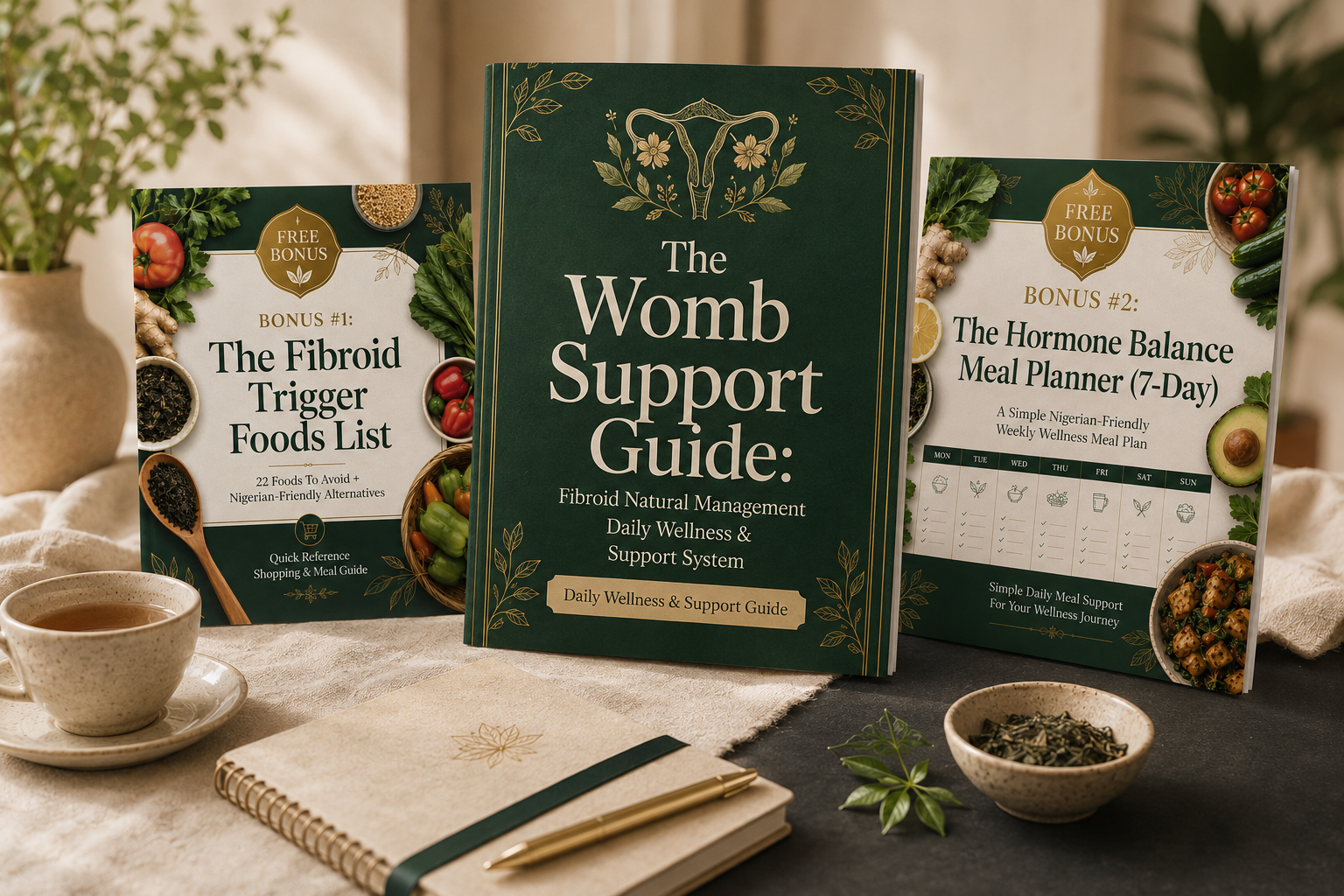
Fibroid Natural Management Daily Wellness & Support System
A complete, practical daily framework — rooted in 28 years of clinical experience — that Nigerian women with fibroids can use at home to reduce bloating, manage heavy periods, ease pelvic pain, and start feeling like themselves again.
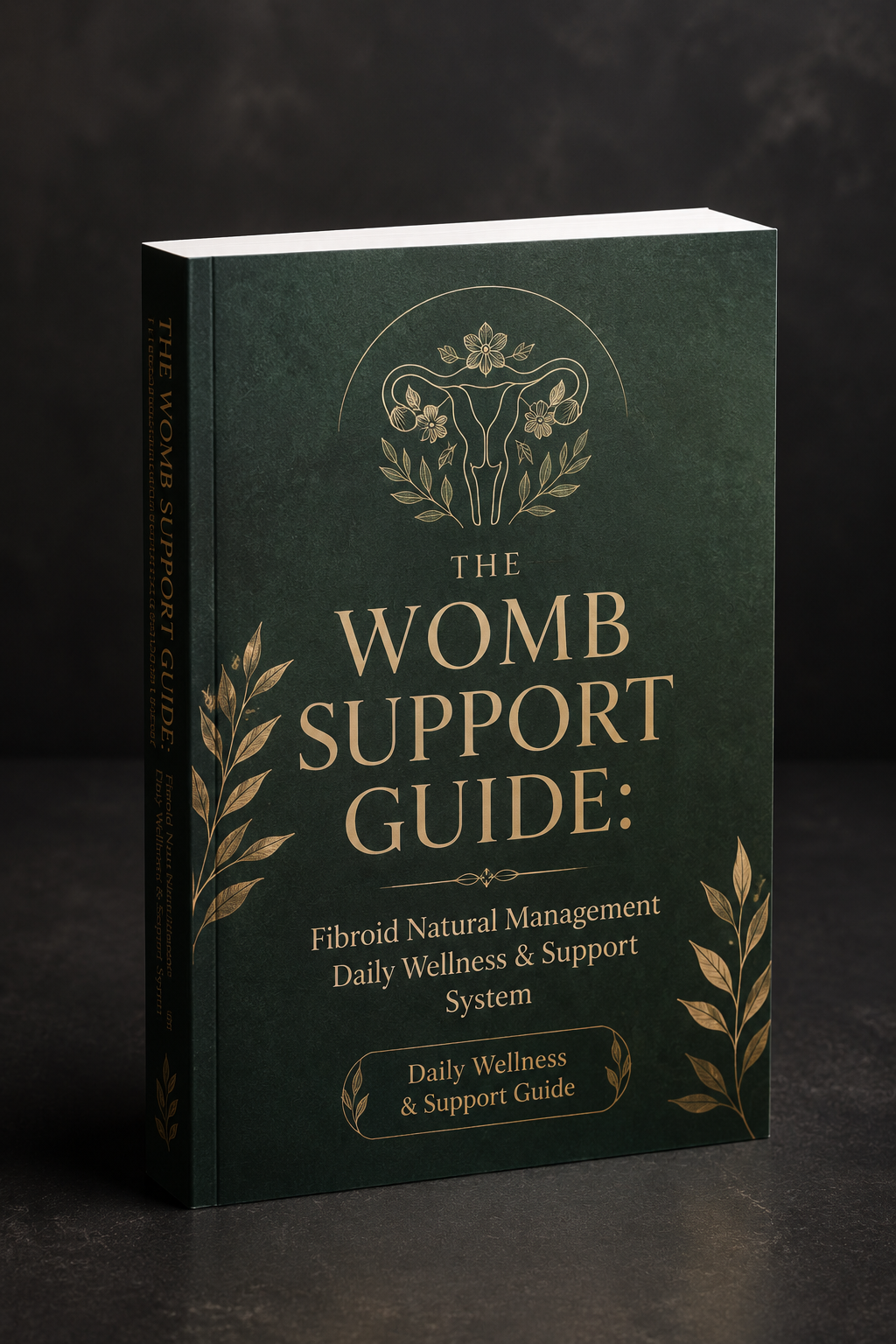
Inside This E-Guide, You'll Discover:
- The 5 foods that silently feed fibroid growth — and the Nigerian alternatives you can swap them with immediately, starting with your next market trip. These are things most women eat daily without knowing the damage being done. — Pg. 4
- Mama Adaeze's warm compress technique — the exact oil, exact temperature, exact duration, and the 3-times-weekly timing that makes it effective for reducing pelvic congestion and bloating. Not the vague version you've seen online. The precise clinical version. — Pg. 9
- The daily anti-inflammatory herbal tea protocol — using ingredients available in any Nigerian market or kitchen, combined in a specific way and taken at specific times of day for maximum anti-inflammatory effect on the pelvic region. — Pg. 14
- 3 hormone-disrupting household items most Nigerian women use daily — without knowing they are directly feeding the oestrogen dominance that drives fibroid growth. One of these is almost certainly in your bathroom right now. — Pg. 19
- The 15-minute daily pelvic wellness movement sequence — designed specifically to reduce pelvic congestion and improve circulation to the uterus. No gym required. No fitness experience needed. Can be done in your bedroom before you leave for work. — Pg. 23
- How to track your cycle to detect real improvement — and the 6 specific signs that tell you the routine is working, even before your next scan. Because you deserve to know that progress is happening. — Pg. 28
- The monthly self-assessment checklist — a simple one-page tool to measure your own progress at home, month by month, without needing to run to a hospital every time you want to know if things are improving. — Pg. 33
Real Women. Real Testimonials.
Just So You Know... Putting This Guide Together Cost Me Over ₦134,800.
- Professional research compilation and clinical cross-referencing of all 5 methods in the routine
- Dedicated medical writer to document Mama Adaeze's framework accurately and safely
- Professional editor — two full editing rounds, plus a final proofreading pass
- Graphic designer for the PDF layout, cover design, and all visual elements
- User testing — 12 women tried the draft guide and gave detailed feedback before the final version was completed
I'm not going to charge you ₦134,800...
I won't even charge you ₦67,000
Not even ₦30,000
In fact, you won't even pay ₦20,000
A fair price for me would be just:
₦15,000 ₦9,800One-time payment. Instant access. No subscriptions.
⚠️ This Discounted Price Is ONLY For the First 40 Women Paying Today. After That, Price Returns to ₦15,000. ⚠️
🎁 WAIT! I Have a FREE Gift For You...
If you're among the first 40 women paying today, you'll receive these two incredible BONUSES alongside your guide — at absolutely no extra charge. (TODAY ONLY)
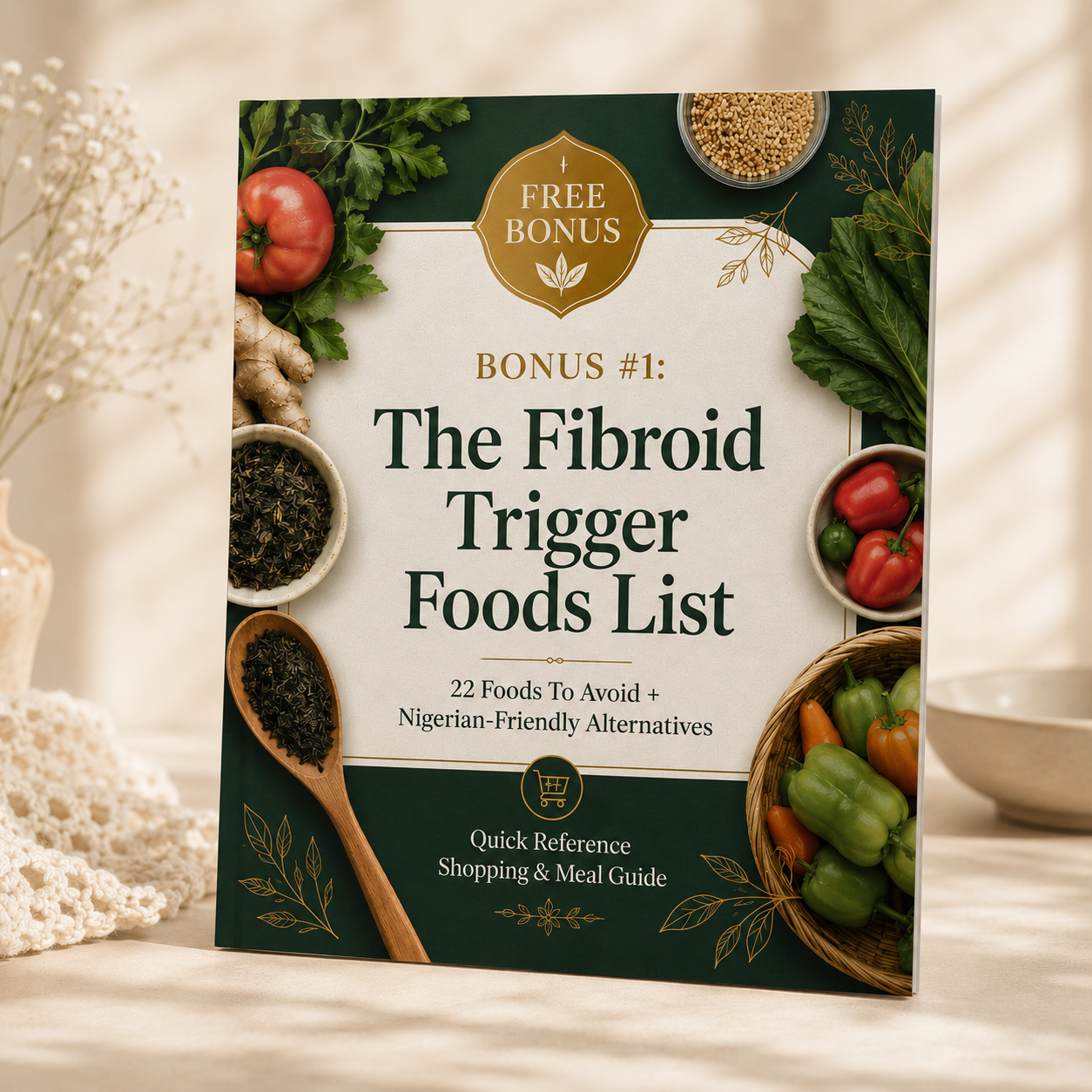
🎁 BONUS 1: The Fibroid Trigger Foods List
A quick-reference PDF of 22 specific foods that worsen fibroid symptoms — formatted for Nigerian meals and market shopping. Print it. Stick it on your fridge. Take it to the market. Never accidentally eat a fibroid-trigger food again.
Valued at ₦3,500 — Yours FREE today
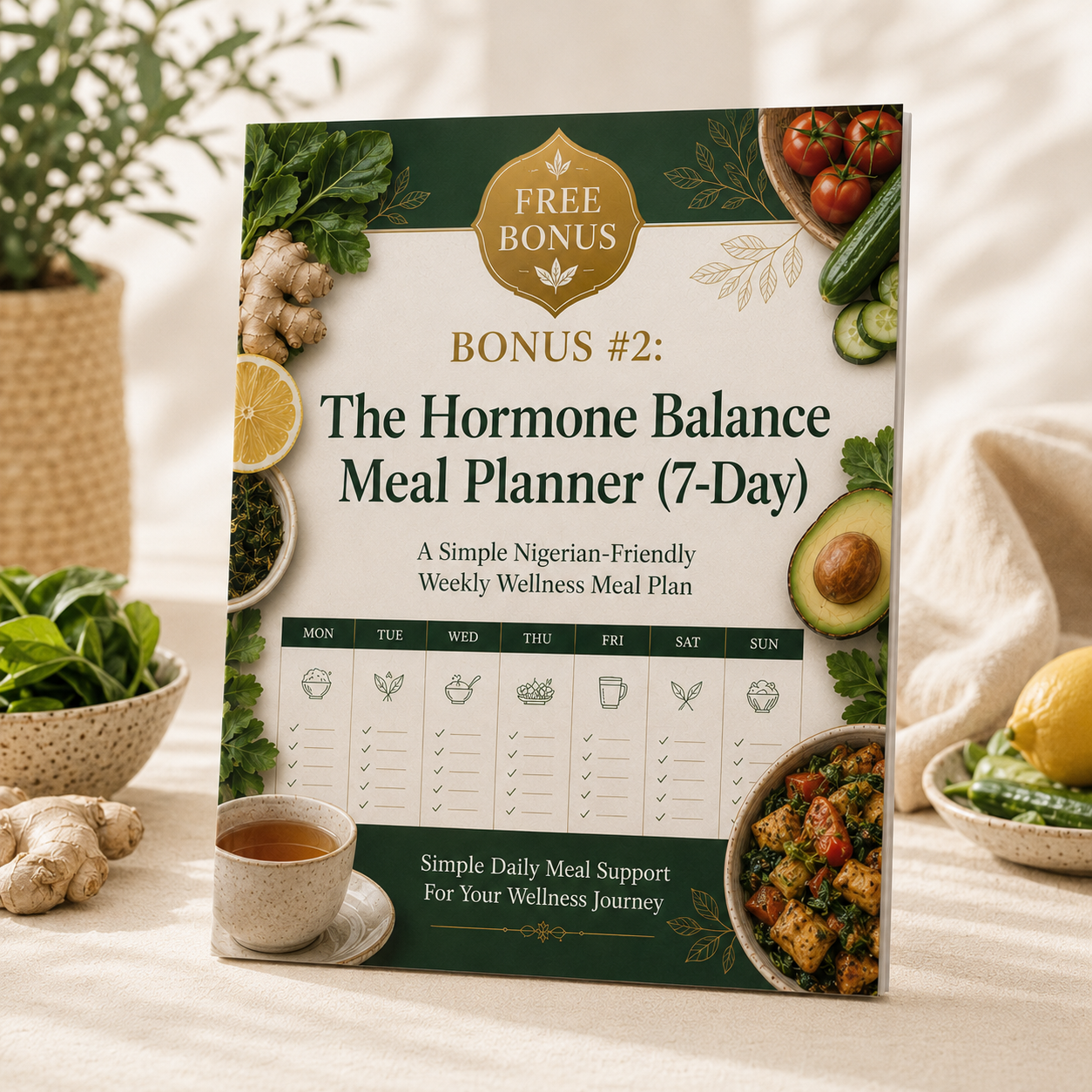
🎁 BONUS 2: The Hormone Balance Meal Planner (7-Day)
A complete 7-day Nigerian meal plan designed to reduce oestrogen dominance — the hormonal condition that drives most fibroid growth. Every meal uses food available in Nigerian markets. No imported ingredients. No complicated cooking. Just a simple, sustainable weekly plan.
Valued at ₦4,500 — Yours FREE today
👀 See What Is Happening Right Now...
Only 13 slots remaining at ₦9,800.
Bear in mind — you are not the only one viewing this page right now.
My Bold 30-Day Risk-Free Promise To You
Still feeling unsure? I totally understand. You've spent money before on things that didn't work. I did too. Which is exactly why I'm making you this promise:
Use the Womb Support Guide consistently for 30 full days. Follow the routine — the compress, the tea, the movement, the food adjustments. Give your body a real chance to respond.
If you don't notice any reduction in your symptoms — lighter periods, less bloating, or reduced pelvic discomfort — just send me a message. I'll refund every single naira you paid.
No questions asked. No stress. No back-and-forth. Just a full refund, promptly processed.
I'm confident enough in this method to stake my own money on it. The only risk here... is continuing to do nothing.
More Women. More Results.
Right now, you have two choices in front of you.
✅ Option 1: Take Action Today
Get the Womb Support Guide right now for just ₦9,800. Follow the simple daily routine for 30 days. Experience lighter periods, less bloating, reduced pelvic pressure. Stop dreading your cycle. Stop wearing only dark colours. Stop missing work, missing events, missing your own life. Start feeling like yourself again. Show your husband — or show yourself — what your body is truly capable of when it has the right support.
❌ Option 2: Close This Page
Go back to the serrapeptase vendors. The herbal tea that doesn't work. The strict diet you can't sustain. The hospital visits that end in "monitor it" or "surgery is the only option." Keep soaking through pads. Keep wearing dark clothes. Keep explaining your bad days to people who don't understand. Keep suffering in silence, every single cycle, waiting for something to change that will not change on its own.
Maybe God wanted you to see this page today. Maybe this is the moment that changes everything — the way that quiet Christmas evening in Udi changed everything for me.
⏰ The clock is ticking. Only a few slots remain at ₦9,800.
Have questions? Send a message to our support team via WhatsApp. We typically respond within a few hours.
This guide is intended for educational and wellness support purposes only. It does not replace professional medical advice. Please continue consulting your healthcare provider for your fibroid management.
Share Your Experience